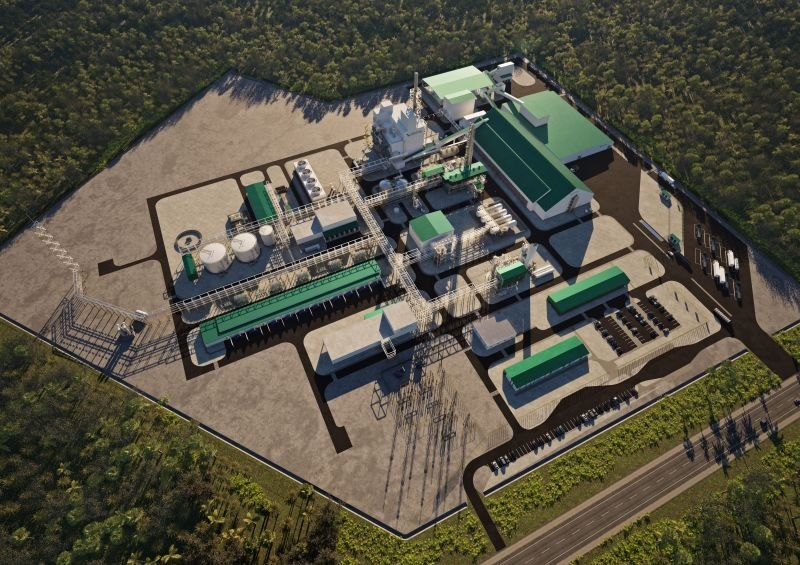
Impact Fund Denmark, together with Danish pension funds, is now investing DKK 223 million (USD 35 million) in Project Villeta in Paraguay, which is a groundbreaking green project to produce green chemical fertiliser based on hydrogen produced with renewable energy, and which is among the first commercial plants in the world that can do so on an industrial scale.
The plant will be one of Paraguay’s largest private investments ever for a total project amount of more than DKK 4 billion.
Paraguay has a special position because the country’s electricity comes primarily from hydropower. Fertiliser production is characterised by being highly energy intensive and traditionally using fossil fuels. In Project Villeta, the entire process is to be assembled in a large industrial plant, where clean renewable electricity is used to produce green hydrogen, which is then converted into ammonia and then into fertiliser, but with a much lower climate footprint than traditional fertiliser.
Significant climate and development impact
Fertilisers have a significant climate footprint globally. Ammonia is a key building block in chemical fertilisers, but production today is very energy-intensive and typically based on fossil gas. According to the IEA, ammonia production accounts for about 1.3 percent of CO2 emissions from the global energy system. By using green hydrogen from renewable electricity, emissions from production can be significantly reduced. Over the lifetime of the project, the plant is expected to avoid 14.5 million tonnes of CO₂ by replacing production from fossil-based manure plants.
Project Villeta will sell the fertiliser to Paraguay, Argentina and Brazil in particular, and can help reduce the region’s dependence on imported fossil-based fertilisers. This is important in a region where agriculture plays an important economic role, and where more than 90 per cent of nitrogen fertiliser consumption is imported today.
The project will produce around 260,000 tonnes of green fertiliser per year, and is expected to create more than 1,200 direct jobs in the construction phase and around 200 permanent skilled and unskilled jobs afterwards. In addition, there are derived effects in transport, logistics and construction. Overall, the project is one of the largest private investments in Paraguay’s history and an example of how green energy can be used to create industrial development and less dependence.
This is exactly the type of investment we want to create in Impact Fund Denmark. Investments that can deliver attractive returns and long-term value creation. Together with Danish pension funds, we are helping to build new, greener industry in a region with great potential for growth and development, while the investment contributes to significantly reducing dependence on fossil fuels.
Strong international backing and EDFI guarantee
The project follows on from the EU‑Mercosur trade agreement concluded in early 2026, which is a historic free trade agreement between the EU and South American countries, where Danish companies are expected to gain easier access to a large market with 720+ million people.
The investment is made by Impact Fund Denmark through the SDG Fund II with the participation of the Danish pension funds PenSam, P+, PFA, PKA and PBU. The investment is covered by the European Development Finance Institutions’ (EDFI) Renewable Energy Transition Guarantee. In close cooperation with the European Commission, Impact Fund Denmark uses guarantees as a catalytic tool that reduces the risk for private investors, while creating significant development and climate impact.
Other investors in the project are IFC, DEG, Hy24 and Sudameris, and IDB, EIB and FMO as lenders. Project Villeta is expected to be completed by 2030.
The investment is made through the SDG II Fund and is supported by funding from the European Union. The project also benefits from EDFI Carbon Sinks, a guarantee managed by EDFI Management Company and funded by the European Union under the EFSD+ programme, as part of the EU’s Global Gateway strategy.


External Communications Director
Thøger Kirk
+45 53 76 08 05